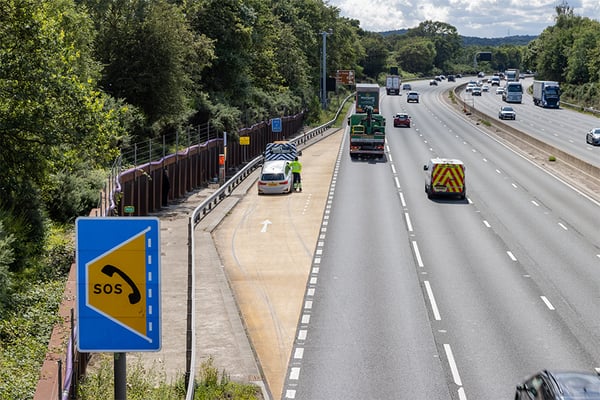
You’ve probably seen the blue signs on the motorway saying ‘Emergency area’ (formerly known as emergency refuge areas/ERAs), but do you know what they are and when you can use them?
With the introduction of smart motorways in the UK, these emergency areas (or EAs for short) have been added so motorists have somewhere to pull over in case of an emergency.
What is an emergency area?
An emergency refuge area (now known as just an ‘emergency area’) is a ‘place of relative safety’ you can pull into if you have an emergency and need to stop driving on an all-lane running motorway. You'll find emergency areas at regular intervals along smart motorways. They are signposted as ‘SOS’ lay-bys and are set to the left of the left-hand lane, recognisable by the bright orange tarmac.
Introduced by the government in 2006, the M42 was the first road to feature a smart motorway.
Smart motorways are designed to manage traffic flow and increase driver safety. However, The AA has long since contested the safety of smart motorways, campaigning for greater safety features and the scrapping of new smart motorways.
We provide 24/7 roadside assistance.
How far apart are emergency areas?
You’ll find these EAs at varying intervals along all-lane running smart motorways (between 500 and 1,500 metres), with an emergency phone available so you can call for help. Following AA campaigning, National Highways have committed to ensuring that refuge areas are no more than 0.75km apart from each other, with a retrofitting programme for existing smart motorways.
Each emergency area has a highly visible orange road surface and a large blue sign with an orange SOS telephone symbol on it to improve visibility.
When to use an emergency area
You should only use an emergency area if you’ve broken down or have been involved in a collision while on a smart motorway.
While driving you’ll see countdown signage for emergency areas at every 300, 200 and 100 yards. Within the EA there is a marked "suggested" stopping point which allows sufficient room for the casualty vehicle and an attending recovery/breakdown vehicle. You should stop in the suggested stopping point and switch on your hazard warning lights.
You should NOT use an emergency area in any of the following scenarios:
- To rest, take a break or park your car if you’re not in an emergency situation
- If the emergency area is already occupied with other broken-down vehicles
- If it would be quicker and easier to take the next motorway exit instead
- If for any reason, it’s unsafe to enter the EA (the road may be busier than usual, for example)
What to do if you have stopped in an emergency area
Make sure to follow these steps if you’ve stopped in an emergency area on a smart motorway:
- All passengers should exit the vehicle on the left-hand side where possible and stand behind the crash barrier, as far away from passing traffic as possible
- Use the SOS telephone (free of charge) to call a representative at National Highways who will provide further instructions
- Always use the SOS telephone first, but if it isn’t working for any reason use your mobile phone to call your roadside assistance provider
- Wait for your breakdown service to assist you, as they will have all the necessary tools needed, or will be able to tow you to a garage if the issue can't be repaired on the side of the road
Don't attempt any repairs to your vehicle in one of these emergency areas, no matter how minor, and don’t try to flag down other drivers for assistance.
How to rejoin the motorway safely
Emergency areas are only short lay-bys and they're not long enough to build up speed before re-joining the motorway.
Before leaving, you must contact the Regional Control Centre using the SOS phone. They’ll dispatch a National Highways Traffic Officer and/or set signs and signals (red 'X') to help you back onto the motorway safely. Do not attempt to leave until you have permission from the control centre or traffic officer.
What to do if you’re unable to access an EA
If your vehicle has a serious issue while driving on a smart motorway and you’re unable to access an emergency area, make sure to follow the steps below:
- If you come to a stop in a live lane on the motorway, stay in your vehicle
- If it’s safe to do so, get out of the vehicle and stand behind the crash barrier to the left of the motorway
- Keep your seatbelt on
- Switch your hazard lights on
- Call 999 immediately and let them know your whereabouts and which lane you’re in
- The police and National Highways will arrange for your lane to be closed with a red x sign, and will send help
- Wait in your car for assistance to arrive
Why do smart motorways have emergency areas?
Smart motorways sometimes use the hard shoulder as an extra lane, either permanently or to ease traffic congestion. EAs have been introduced to replace the hard shoulder, although they are only located at specific intervals along the motorway and are designed for emergency use only.
Why have EAs been introduced?
Emergency areas were first introduced with smart motorways and the removal of hard shoulders on all-lane-running motorways. The government claimed that switching from hard shoulders to emergency areas would improve traffic flow and the safety of drivers. However, The AA have contested the safety of smart motorways and campaigned for the reintroduction of hard shoulders, due to several fatal and serious incidents that could have been avoided with their presence.
What is the difference between emergency areas and the hard shoulder?
Hard shoulders were present on all motorways before the introduction of smart motorways in 2006. These are lanes on the leftmost side of the motorway that are reserved only for breakdowns and emergencies – and are separated from the other lanes by a solid white line and a rumble strip. No traffic is allowed to use the hard shoulder for normal driving.
Emergency areas, on the other hand, are only present at certain intervals on smart motorways. They’re set off to the left side of the leftmost lane and aim to provide a place of relative safety for drivers to stop in an emergency or breakdown situation. Emergency areas vary in size but are approximately 100 metres in length, meaning there’s not enough space to build up speed and rejoin the motorway. Because of this, emergency areas feature telephones that must be used to contact National Highways, who may dispatch a National Highways Traffic Officer and/or set signs and signals (red 'X') to help you back onto the motorway safely.
Why choose us for breakdown cover?
- UK drivers have consistently rated us as the best breakdown service against all other major breakdown providers
- Our patrols will usually get to you in less than an hour and get you back on the road in around 30 minutes of arrival
Verify at theAA.com/best.
Last updated: 26 June 2024 | Author: The AA