Serpula lacrymans. No, not a Harry Potter spell, it's the scientific term for something homeowners dread – dry rot.
Dry rot has a way of appearing without your knowledge, only revealing itself when it's almost too late to prevent serious damage to your home's timbers. Read on for tips on identifying and treating it.
What is dry rot?
Dry rot is a type of wood decay, where the fungus Serpula lacrymans attacks and digests the surface of timber in a building.
Despite the name, it only affects damp wood. In an enclosed dry environment – your home – the timbers that form the floors and roof usually have a moisture content between 9 and 16%. When the moisture content is higher than 21% for a long period the timber then becomes prone to fungal or insect attack.
So as well as discovering dry rot, it's important to find the source of the increased moisture before any treatment. Look for signs of rising damp, areas of poor ventilation, leaking pipes, plus broken gutters and drainpipes outside. Less obvious is a damaged damp course in an external wall.
The cause of the moisture should be repaired immediately, and affected rooms dried out by heating and ventilation. You'll then need to work out the extent of the dry rot by removing floorboards around the area, and any wall plaster where a structural timber, such as a floor joist, is embedded in a wall.
The stages of dry rot
- Spores – Dry rot fungus exists almost everywhere as spores in the air. It's pretty harmless until it comes into contact with timber that has a high moisture content..
- Hyphae – When the spores land on the moist timber, it'll grow as hyphae, cobweb-like strands that start to break down the timber.
- Mycelium – As the hyphae grows, they merge and spread as a cotton-wool like substance called mycelium.
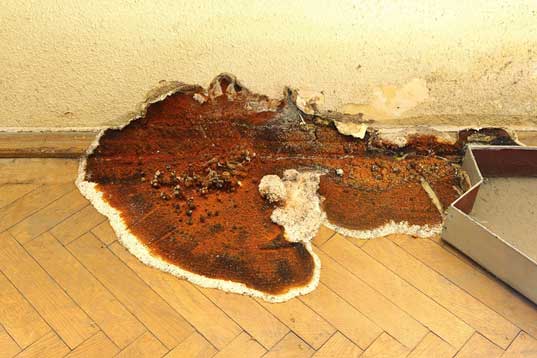
- Fruiting body – At the final stage of dry rot, the fungus takes on a mushroom-like mass. This starts to produce new red spores that become airborne and lead to quicker spreading of dry rot around your home.
What does dry rot look like?
Signs of dry rot to look out for include:
- A distinct musty, damp smell.
- The appearance of the cobweb-like hyphae and cotton-wool like mycelium.
- Deep cracks in the wood.
- Darkening of the wood.
What are the consequences of dry rot?
Dry rot can affect the stability of a building which is dependent on the infected structural timbers. This will be more expensive to fix if left too long.
The cause of dry rot could also have an impact on your family's health. As well as a higher level of dampness in the home, the spores can affect people with breathing conditions, with babies and older people particularly vulnerable.
How to treat dry rot
After evaluating the problem and solving the cause, you'll need to dry out the affected timbers. Some of the damaged timbers may need to be replaced, and you'll likely have to call in a professional when they structurally support parts of your building. If the building is listed, do contact your local council conservation officer before removing any woodwork.
What's the difference between wet rot and dry rot
You might think to yourself, 'wet rot, dry rot – it's all the same', but they are slightly different, and how you should treat them too. But both conditions occur in timber with a high moisture content and they are both due to fungal decay.
Wet rot fungi appear in persistently wet conditions, where the timber has a moisture content of 50 to 60%. So think of that rotten garden fence or gate post. The fungus will stop growing when the source of moisture is tackled or the timber is treated against damp.
Is dry rot covered by insurance?
Dry rot is a general exclusion for most insurers. If the dry rot can be proven to be the fault of bad building work – like, for example, botched plumbing – you might be able to claim back some of the costs.
It's always wise to contact your insurer to let them know about the problem anyway, and they'll let you know if you're covered for certain costs.


